Episode 10: Hellebore
Episode 10: Hellebore
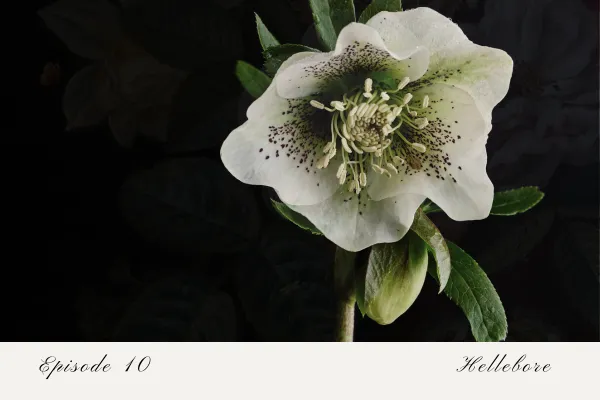
On this month’s episode of Flowers & Folklore Keeley tells you all about the hellebore.
You can find Flowers & Folklore on Spotify, Apple Podcasts, Pocket Casts, YouTube and lots of other places.
Hi, I'm Sarah.
Hi, I'm Keely.
And you're listening to Flowers and Folklore. If you love flowers and folklore and odd floral facts, then you are in the right place.
Reading and learning about flowers, their history and folktales associated with them is a big hobby of ours. There's so many regional stories and lore for each flower, so you may have read or heard something different. You're absolutely welcome to get in touch and share the stories you know.
We'll share the best way to get in touch at the end of the episode. Okay, so Sarah, today... I'm taking you into the world of hellebore. I was so surprised at how much contradiction there was and contrast there was. not just within the research. There was also difference in symbolism and meanings that were completely
contradictory to each other, both a healing flower at times but also extremely toxic, that there is some themes rooted in its origin in Christianity, but also it seems to have quite a fascination within the occult, which seems like two opposing worlds coming together there for this one flower. So I just thought that was really interesting.
But that's my little overview of wonder for the hellebore. But now I'll bring you five facts. So firstly, they can be grown in both single and double forms, which the double form doesn't really look like you'd think it would be like two flowers, but it doesn't. It just looks like a bigger sort of more full flower.
They also come in a variety of colours from whites and greens, pinks to really deep purple, almost black. They are available in patterns rather than a solid hue, or they can be available in patterns rather than just a solid hue, so it can be speckled or the edges can have contrast colour.
They can grow happily in the shade, which is my fourth fact, and they have a lengthy flowering period, so from winter through to spring.
I love that. I'm so excited for this.
Yes, it's a pretty fascinating little flower. Originally from inland regions of Central and Southern Europe, the humble hellebore is a member of the ranunculus family, which also includes buttercups. The Hellebore or Helleborus, which is its botanical name, is also known by many common names, such as Lenten Rose, Christmas Rose, Winter Rose, Christmas Aconite and Nischwurz,
which is a very popular German name meaning, and also sounding like, sneeze wart in English. It's no doubt inspired by the fact that any part of the Helleborus plant induces sneezing, if dried and ground to a fine powder. And that's due to the fact that hellebores contain proto-anamonin, which I have just heard of today.
That's incredible. I did not know any of that. That's... Pretty cool. Fascinating. I'm just trying to think. Do you know whether it makes you sneeze when it's fresh?
I did read somewhere that it can. If you sniff it too closely to your nose or something, it can actually irritate the nasal passages and cause you to sneeze. So it's probably not one that you want to be really getting too close to your face, it sounds like. And it has actually so many more common names.
And I think that's due to the fact that it has so many different little tales on and stories around it. I will share a couple of how it got those common names later. But I did want to just clarify that the Christmas rose and the Lenten rose are different. They are both hellebore, but Christmas roses, and again,
I'm saying this lightly, this is apparently, I feel like I'm kind of gossiping, like I heard that this But I've also read completely differently. Christmas roses bloom earliest, so they are the December blooms with pure white flowers. And Lenten roses are later, they align with the Lent period and are in a wide range of colours. Again,
I've read articles where it says that the Christmas rose and it was referring to the black hellebore, so I'm not sure if that's a mistake and the account isn't correct or if it's just, if it's true and I'm just currently confused and at the mercy of our listeners. But if what I've read the most is correct,
If it's white and it blooms around a winter Christmas, not an Australian summer Christmas, it's likely a Christmas rose. And if it's colourful and it blooms in spring, it's probably a Lenten rose. And by spring, I mean UK spring.
Yeah, that's really fascinating. Like I knew that it was referred to as a Christmas rose and I just assumed... Yeah, it was to do with the flowering season. But I hadn't heard like the differences with colour and stuff. But I mean, the dark hellebore is spooky.
Like that's quite a haunted looking flower because it's one of my favourites. So that to be associated with Christmas seems weird, but it makes sense when it's white. It does look like a Christmas rose.
Yeah, I wondered if maybe when that person, when I was reading that article, maybe it was they just assumed that the Christmas rose was meaning any kind of hellebore, not just the white version of the hellebore. But I do kind of love that if it was kind of aligning with the, you know, the Christian theology there,
that Christmas being the white and then like Lent being like kind of sunrise colours, you know, around Easter. I don't know. It's kind of quite lovely that it sort of fits in that period. I quite like that.
No, I love that.
The name hellebore, despite the way it sounds, has nothing to do with hell, but its botanical name, helleborus, comes from the Greek, I don't know how to pronounce it, elene, meaning to kill or injure, and borer, meaning food. So it's basically... to kill or injure food, which is not great.
So perhaps the name itself is a bit of a clue to treat this flower with caution. But despite this, it somehow for a long time was used for healing and medicinal purposes. which I'll get to in a moment. But before we do that, I wanted to share with you the meaning of the flower and its symbolism.
So according to the book Floriography by Jessica Rue, its meaning is we shall overcome scandal and slander. It also states that Hellebore was thought to have magical powers and was at times associated with witchcraft, which we will talk about again in a minute. The Complete Language of Flowers by Teresa Dietz lists the hellebore's symbolic meanings as anxiety,
calumny, which I had to look up. It means, it interestingly is a word to mean the making of false and defamatory statements about someone in order to damage their reputation or slander, which is weird because it's meant to mean that we'll overcome scandal and slander. So relief or relieve my anxiety, scandal, tranquilise my anxiety, wit,
while also noting its possible powers as protection. It was also once believed that bringing a vase of Helleborus into a room full of dreadful negativity would push out the unpleasantness and replace it with tranquility. It's connected with madness and delirium in medieval times, according to Folklore and Symbolism of Flowers, Plants and Trees by Joanna and Ernst Lerner.
That's so fascinating. And you're already seeing that duality of the flower, where it's a bit negative in certain circumstances, but then also really powerful and pushing out badness in the other yeah interesting and that's actually such a good
segue to the next piece I have which is that winter flowers in general are admired for their ability to inspire new beginnings in the midst of darkness and cold and the hellebore captures this beautifully so yes it's almost that's the first time I've kind of connected that but it's a winter flower so it blooms in darkness in
cold in frost and And it's this beautiful bloom. So it already has that contrast and that duality within the flower itself. I love that. So no wonder it has kind of both sides of the coin in meanings and contradictions. It couldn't not. And I loved this little summary from author Alice T.A. Quackenbush, who says,
Probably blooming in any other time, this plant would seem of little garden value. When one remembers that it is possible to dig through the snow and find bloom, it becomes precious. The Christmas Rose, self-published by Arthur E. and Mildred V. Ludi in 1948, wrote, There is a flower that strangely loves the bitterness of winter and blooms through
the crystal of ice. It is the Christmas Rose, with a history worth telling.
Can I pick a fight with Alice?
Definitely.
Because I appreciate that. I understand exactly what she's saying. I do think the hellebore is particularly precious because of when it flowers. Because flowers are rarer in winter. Yes, they're special. But I would also argue... They are so beautiful. I think I would still love them if they bloomed at different parts of the air.
Yes.
But as I'm saying that, I am doubting myself now.
No, don't doubt yourself. I agree. I loved, I fell in love with hellebores before I knew they were a winter flower. So it's not the only reason that I love them. It's just, I just loved that it was like an added thing that these beautiful little, they're not creatures, but I keep thinking of them as creatures.
I think you can refer to them as creatures.
I feel like they are creatures, but they're not. But I do, don't throw tomatoes at me, guys. I know they're not creatures, but to me, in my hand, they're little creatures and they come out out of the snow or out of the cold and they're just, that's really resilient and beautiful. So it just,
I feel like it adds an extra layer of why to love them, but not that I wouldn't love them if they didn't have that. So I feel like that was a little bit harsh, but I still loved it.
Yeah, no, I completely agree with that. I think I particularly love them because you can get like really, really dark colors and I love a moody flower. So I'm always gonna, even if they were to bloom in summer, I still want a moody flower.
I actually do totally agree. I found them at a recently, only a few months ago was the first time they really stood out to me at a plant shop. I was there with my brothers and they were this gorgeous, like rich, velvety, dark purple. And I was like, what is this flower? This is next level stunning.
And it was that dark, dark hellebore. And that's when I found out they're called hellebore or winter rose. And I was like, okay, I love them. I need them in my garden. I just, I was already obsessed. Yeah.
So I'm really interested that they grow in Australia.
Yeah.
Is that not, is it not too warm?
It's so funny that everybody thinks. Australia gets really cold as well. Like not, obviously we don't get, I mean, we get snow, but so where I am in Canberra, we don't get snow. you know, minus 20s or anything like that. But I was often going to school in minus five degrees and things like that and
often have to scrape ice off my car. Not big, not huge amounts of snow or anything like that, but my car or if you, you might drive from somewhere and you scrape the ice off your car and then you hop in the car and it's literally frozen over again before you get home.
We do get cold as well. So that's why we can get tulips and things like that.
Ah, okay. And do hellebore need the cold?
They definitely like shade. They love the shade. But I assume if they are winter blooms, they'd have to be happy. I can't imagine they'd want to be in the warmth.
Yeah. I'm the same. I bloom in the winter as well. I hate the warmth.
That's so the opposite.
Oh, is it really?
Yes. I'm such a winter grump.
Oh, that's funny.
I'm solar powered. I hate the cold. I hate it.
My sister's the same and she would just, she would not do well in Scotland. Not that it's like that much warmer down south, but yeah, she always seeks out the heat and I always seek out the cold.
I could handle the cold if I was in Scotland and I had something so beautiful to help me get through the cold. And also, this is my petition for starting Christmas as a winter holiday, not just a December holiday, because... It's not fair that you guys get the cold and it's filled with fairy lights and
sparkles and beautiful Christmas tradition and we just have the cold and it's depressing. So I feel like that should be switched around. So I'm trying to bring it back.
Yeah, it totally should. Yeah, nonsense that you have Christmas in the heat.
100%. Like, yeah, it's just bizarre. Okay, so now we will get into the contradictions around its healing powers and how very, very toxic it is. So I cannot state more explicitly, please do not try to administer hellebore at home in any way, shape or form.
But here are the uses that it was believed to hold in early medicine times. Other than its perceived ability to protect from evil, it was used to treat gout, paralysis, epilepsy and madness, as well as being used at times as a strong laxative or diuretic. Now, in modern medicine, only hellebrine, which is found in the roots,
is used in some cardiovascular disease medicines. However, the flip side of this is that all parts of the plant are completely poisonous. The sap is irritating to the skin and just some of the symptoms of ingestion include burning of the mouth, vomiting, dizziness, nervous system depression, convulsions, tinnitus, vertigo, swelling, heart attack and even death.
So having said all of that, you might be wondering if it is okay to have the hellebore in your garden and thankfully these lovely yet toxic plants are actually safe for home gardens as accidental poisoning to people or pets is almost impossible as hellebores taste
extremely bitter and the amount needed to kill a human or animal is considerable. So that's the good news.
Oh my goodness. Hearing all of that has made me realise I'm... I should probably wear gloves.
Quite possibly.
I mean, I'm not going to do that. It slows me down.
You're not going to do that. Yeah, it's a trade-off, definitely. So diving further into its medicinal background, Hippocrates administered Helleborus as a laxative and diuretic. Helleborus was also considered to be a remedy against mental illness, as I've said. He also is credited as being the first physician to apply the theory of the four humours in practical medicine.
Although he didn't come up with the four humours, he was the first one to actually apply it. And this is the foundation for why hellebores were used in the early medicine. So this is where I went on a bit of a rabbit hole because I wanted to understand what the four humours were,
why was a human not funny and instead somehow medical... So I started to research how it was connected and I found that the word humour in this context, according to the Encyclopedia of Britannica, comes from the Latin liquid or fluid. So you already know it's going to get gross.
It was believed the human body held four humours, black bile, blood, phlegm and yellow bile. I hope nobody's eating while you're listening to this episode. so the general thinking here was that if the human body had an excess of one of the four humours it would cause illness and from what i understand it was usually
believed that it was the fault of the patient that they had this excess of this particular humour so they were also thought to be produced by different organs so blood for example may have been believed to be generated in the liver And then this theory continued to just evolve and eventually didn't just contain the four humours,
but it then brought in four elements, four qualities, four seasons and four ages of man. So, for example, it then included earth, fire, water, air, hot, dry, cold, wet and so on. And this approach to medicine was used for approximately 2,000 years until it was proven wrong,
although some of the language is still used in common expressions today, such as being in a good humour or having a melancholic temperament. So to oversimplify the medical approach, if one humour was believed to be in excess and making someone sick, it needed to be purged from the body.
And we see this in the first example I thought of was Sense and Sensibility. When Mary Ann is so ill, they try to drain the sickness from her by purging her blood. they drain it into a bowl to try and help her revive. However, what does all this have to do with Hellebore?
So Hellebore was used when the black bile humour was thought to be in excess and the black bile was connected to melancholy and madness. So there was a meaning to the rabbit hole in the end.
That's fascinating. It makes sense why... You're not just humouring me, are you?
Yeah.
i had to that was incredible i just thought of that on the spot i'm really tickled by that i don't even remember what i was gonna say now that's sorry i'm very tickled oh you're going we're such nerds i know i know as soon as the puns come out
you're like oh no i know where we are now
What was I going to say? Oh, it makes sense now. It's starting to make sense why people consider it such a spooky flower, I guess. Because that is quite... graphic, I guess.
Yeah. Yes, definitely. Definitely. Yeah. And I was glad that I did go down that rabbit hole because it did help me to, because I could not understand. I just kept thinking, how did this used to be? If you keep telling me that this plant is so toxic,
yet I'm also reading over and over again that it used to be used for healing and how, how does that make sense? And so this was the reasoning and the logic that just helped kind of ground all that other information. And then even further than that, as we'll look into,
like as it moves into witchcraft and things like that, it also kind of, I feel like it gives it a foundation for that as well. So Discovering the Folklore of Plants reads that John Gerard, who I believe was an English herbalist, recommended Hellebore for those molested by melancholy and for mad and furious men.
And it's possible that the reason the flower was connected to mental health and melancholy, or another reason, is because the flower itself, at least the darker ones, look a little bit depressed and gloomy. Because the flowers themselves tend to droop over. They don't tend to be upright and follow the sun, like a sunflower, for example.
They kind of droop. And also, if they're dark, coloured, then yes, it does kind of have a gloomy vibe too. So I don't necessarily think they look like a depressed flower. I think they're still quite beautiful, but it was believed back then that they looked a bit gloomy. The Anatomy of Melancholy by Robert Burton reads,
"...this melancholy extends itself not to men only, but even to vegetals and sensibles. I speak not of those creatures which are saturine melancholy by nature." as lead and such like minerals or those plants rue cypress and hellebore itself. This book also says, borage and hellebore fill two scenes,
sovereign plants to purge the veins of melancholy and cheer the heart of those black fumes which make it smart. which I found interesting because although this is yet another tangent, borage, the meaning of borage is courage. So that captured me because I wondered if that was why borage got its meaning of courage,
because perhaps being courageous in the presence of melancholy, but I didn't allow myself to jump down that rabbit hole this time.
I love that as a tangent. And I think it's interesting what you're saying about the drooping haired And how that does, it does seem like a sardo flower, which I think is quite interesting.
And there's also an argument around what they meant by melancholy back then, like whether it was in meaning just being depressed or a bit blue, or if it was referring to something more extreme or manic. But again, I left that rabbit hole for someone else to fall down. So let me know if you do.
And it wasn't just used medicinally for humans. So stinking hellebore, which I believe is the white and green variety, was an Elizabethan remedy for cattle disease. And here's another super lovely thing. Please don't eat right now. A slit was cut in the animal's dewlap. And again, I did not want to know what a dewlap was.
Setterwort inserted and left for several days inside the dewlap. And this was called settering the cattle. There's, and also if you know what a dulep is, I don't want to know, don't tell me, there's another instance of early veterinary usage, if we can call it that, but the black hellebore in 1641, Parkinson wrote,
"...a piece of the root being drawn through a hole made in the ear of a beast, troubled with cough or having taken any poisonous thing cureth it, if it be taken out the next day at the same hour." And the shepherd Melampus first realised its properties by noticing its effect on his goats.
Later he cured the daughters of Proteus, king of Argos, of mental afflictions by giving them goat's milk to drink. And this was taken from Discovering the Folklore of Plants by Margaret Baker.
Isn't it interesting that earlier on you said pets and humans wouldn't eat it because it's so bitter. But like nothing applies to goats because goats just eat everything.
That's so funny. So true. And I hadn't made that connection. It had all of these uses, but to actually obtain the flower itself, you had to be careful because if it was done incorrectly, it was believed to bring misfortune or bad luck. And so when people picked them and they gathered them from the roots,
they described it as creating a circle with a sword point around the plant. And then they ate garlic and offered prayers to Apollo and a scalapius, I'm sorry, I can't say that, while the roots were being lifted. So it was a whole ritual around just collecting these flowers. Which brings us into the more spooky side of things.
So according to the Encyclopedia of Superstitions, Folklore and the Occult Sciences of the World, the hellebore has long been considered a plant of evil omen, growing in dark and lonely places. The ancients believed that by strewing or perfuming their apartments with hellebore, they drove away evil spirits.
However, I've also read that it could be used to summon demons. So I guess the door swings both ways there. People also planted it near doorways or scattered its dried leaves to protect homes from malevolent forces. As I said earlier, it was once believed that bringing in a vase of Helleborus into a room full of
negativity would push out the unpleasantness and replace it with tranquility. And similar to this concept, I read that in Dorset, the Lenten Rose or the Christmas Rose should be planted at the doorstep to welcome Christ into your home. According to Discovering the Folklore of Plants by Margaret Baker, the Hellebore is also named as a sorcerer's weapon,
but it doesn't go into much more detail further. as to how, unless it's referring to the usage we described before of using dried hellebore to sneeze out evil spirits. And apparently if someone died while doing that due to the toxicity as they were sneezing and inhaling this flower, they would just blame the evil spirit.
And in the Middle Ages, hellebore was also used in various amounts of witches ointments and salves and healers sold it as a fountain of youth elixir and my absolute favorite is that it was sold as a potion that or a form in a form that was claimed to make people invisible when ground into a fine
powder and then spread on the ground so wow we should bring that one back because that could be useful yeah
Let's bring that back. But I wonder how that would even start because surely you could disprove that very quickly.
I know. I know. I don't know how. Yeah, I would love to know how they figured that one out and how they managed to convince people that that's kind of crazy. So throughout history, it also has some pretty, there's some pretty juicy goss, some ancient goss about the hellebore. In Wicked Plants by Amy Stewart,
it's mentioned as being believed to be responsible for the death of Alexander the Great. So there's a theory that he was given a medicinal dose of hellebore. He was already apparently taking something by cup every night and to help him with some medical issues.
The theory is that he was given some hellebore in that cup and it killed him. However, there is a lot of debate around as to whether it was A, deliberate, and two, whether it was hellebore or something else such as false hellebore. So... It's just, it's all just gossip at this stage.
And this one I found really fascinating. So in ancient Greece, during the siege of Kira, which was from 595 to 585 BC, and also known as the First Sacred War, there was a doctor named Nebros, who just happened to be the ancestor of Hippocrates, by the way, and he discovered there was a major water pipe
for the city and suggested using Hellebore to poison the city. So this group of warriors created a tincture of Hellebore and then poured it down the water pipe, which left the citizens of Kira with diarrhea and vomiting and completely unable to defend or fight for their city, resulting in their complete destruction and winning the sacred war.
And meaning the Christmas rose is one of the first known uses of biological warfare.
That's incredible. Oh, my gosh. Right? How sinister is that? Sinister but very clever.
It is a bit clever, isn't it? Like it's very simple but, yes, very clever. So that one really grabbed my attention. It was also used on hunting arrows by the Gauls. They used a hellebore juice gun. and added it to the tips of their arrows to help make the game as they were hunting more tender.
And if you're like me and you're thinking, that's really interesting, but I have no idea who the Gauls are, I had to look that up. And according to the Wikipedia, the Gauls were a group of Celtic peoples of mainland Europe in the Iron Age and the Roman period, roughly 5th century BC to 5th century AD,
and their homeland was known as Gaul. And they spoke Gaulish, a continental Celtic language. So if you knew that, I'm sorry, I had no idea.
No, I didn't know that. That's fascinating. I feel like I should probably probably should have known that though.
I know I feel bad that I don't know that because I've got like Irish heritage. So I feel like I should have known that. The hellebore got their common name oracle rose by being little weather predictors. So villages would cut 12 stems each year on December 24th, one for each month of the year,
and then the stems were then placed in vases and a month nominated for each flower. And then if the flower opened, it was indicative of good weather and a closed bloom meant it was going to be poor conditions for that month.
I love that. Yeah. Let's bring that back.
I was going to say, should we do it? Do you want to do it December 24th this year? Let's go and get, that's really interesting and see how it pans out. You do it for your end of the world and I'll do it for mine and we'll see how we go.
It was also used as a harvest predictor. So in Tuscany, the peasants would interpret the results of the coming harvest from the appearance of the hellebore plant. And if the plant had four tufts, it would be a good harvest. If it had three, it was going to be mediocre.
If it had two, they could expect a bad harvest. Other uses were that it could be used as a critter repellent, a decoction of four quarts of water and an ounce of white hellebore rhizome. Powdered would destroy caterpillars on 150 gooseberry bushes, just in case you needed to know that,
or mixed with flour made a useful insect dusting powder, which I'm thinking is to get rid of insects, not like dust them and make them look pretty, but I'm not sure.
Where did the 150 come from? That's so precise.
Discovering the Folklore of Plants by Margaret Baker. It's very, very specific. It was also mentioned as a counter irritant and by the Indians in initiation rites. And this is all from Discovering the Folklore of Plants by Margaret Baker. But again, it actually didn't go into much detail or any detail at all about the initiation
rites or anything like that. So it was just a few little offhand comments about... what it was used as but I found those interesting. But now to change tone slightly, and I'm going to tell you the story of how it got, the Hellebore got its common name, the Christmas Rose.
I've heard a couple of different versions of this story, and one was of a young girl and the other is of a shepherd. But essentially, whether it was a shepherd or it was a young girl, they were able to go and visit baby Jesus on the very first Christmas when he was born,
but they had no gift to bring him. And apparently they got down on their knees and they wept and and when they cried and the tears hit the ground, the tears were said to have formed the white hellebore, and that's how it got its name, the Christmas rose.
That's beautiful. I would take hellebore over, what is it, frankincense or whatever it's called. Hellebore is way better.
Yeah. What was it, frankincense, myrrh, and wasn't there a third one?
Yeah, people are going to be screaming at us.
Oh, my goodness.
I have a degree in religious studies. This is embarrassing.
Wise king's gifts. Gold.
How did we remember the other two weird ones?
We forgot gold. Boring one. We don't want money. We just want frankincense and myrrh and hellebore. That's fine. That's very us. Don't brand. Okay, so I did go for a dive into where Hellebore might be mentioned in art and literature and other beautiful things. And there are so many gorgeous botanical prints and images of Hellebore and they're
just so stunning. And we will add them to a gallery on the blog post that goes out with this episode, which will be on Substack. If you are not there, make sure you go and find us. And I'll put the link as well in the show notes.
One of the most prominent places it was found in literature was actually in Harry Potter. So hellebore was used as hellebore syrup, which was blue and possibly poisonous if used incorrectly, and was an ingredient required for four potions. One was the draft of peace. Another one was Volibus Potion, which I think altered people's voice.
Potion number 86 and Wolfsbane Potion. It's specifically pointed out in The Order of the Phoenix, Chapter 12, in a potions lesson where Harry's meant to be making a draft of peace and he's going about making it thinking he's doing a good job and then Snape comes over and says, what is this meant to be?
And Harry's like, well, it's a draft of peace. And Snape's like, oh, really? Read the instructions. Can you actually read? And he's like, yes. And then he says, what does the third line say? He reads the instructions from the blackboard. He says, add powdered moonstone, stir three times counterclockwise, allow to simmer for seven minutes,
and then add two drops of the syrup of hellebore. And it says that Harry's heart sinks. He had not added syrup of hellebore, but had proceeded straight to the fourth line of the instructions, after allowing his potion to simmer for seven minutes. Did you do everything on the third line, Potter? No, said Harry very quietly.
I beg your pardon? No, said Harry more loudly. I forgot the hellebore. I know you did, Potter, which means this mess is utterly worthless. And then Snape vanishes Harry's attempt at the potion using the spell Evanesco. And I'm guessing it's probably used in the draft of peace because of the connections with easing anxiety and things like that.
And the other, this one really brought me a lot of joy. The other place I found it in literature is actually in the Hare and the Tortoise fable, which was, it just brought me a lot of joy to find that out. And the reason for this is likely for its connections with madness.
So the 17th century French writer Jean de La Fontaine wrote, from 1621 to 1695, who wrote The Hare and the Tortoise, wrote a grain or two of hellebore. In the English translation, it said, Tortoise, to the swiftest thing that is, I'll bet that you'll not reach so soon as I, the tree on yonder hill we spy.
So soon, why, madam, are you frantic? replied the creature with an antic. Pray take your senses to restore a grain or two of hellebore. So I really liked that.
That's so lovely. Oh my gosh. I can't believe, I can't believe what you've discovered by going down the rabbit hole. I had no idea that Hellebore was mentioned in this fable.
Yeah, me neither. And I love that. It's such an old, well-known, everybody knows it. It's nobody that wouldn't know that story and yet Hellebore's mentioned in it. So I was really excited by that. And then in my other pursuit of looking for Hellebore use in art, I actually found a really beautiful piece by Margaret Light.
Margaret Light passed away in January of last year, but her design named Arts and Crafts Hellebore was included on the cover of the Inspirations magazine, issue 121, which is a needlework magazine. And it's just the most stunning design. It's a gorgeous depiction of the hellebore entwined with some inspiration from the arts and crafts era,
which is hence the name. So it's all twists and turns. And again, we'll add images to the blog post. So the magazine spoke about this piece of Margaret's by saying, the principles and characteristics of the 19th century arts and crafts movement have had a positive and lasting effect on design and this beautiful study of the
striking hellebore is a testament to the enduring appeal of this style. In this piece, intertwining stems of hellebore have been artfully recreated following the principles of this much-loved design movement.
So to me, it looks like, like the shape of it reminds me of an egg timer, you know, like the old school egg timers where the sand runs through. So there's the big hellebore flower right at the top and then the stems kind of twist down to the bottom.
And then we've got like the little buds hanging off it. And then this is one of the things that I really love about hellebore is that you get the mix of the fully in bloom flowers, but then also the tighter buds.
that are just on the cusp of opening and I think that it just adds a real depth to the flower and so Margaret has captured that like in layers almost down the design where there is like perfect symmetry which is very nice it's also the classic kind
of creamy creamy white and green which is the I guess the classic Christmas
Christmas rose yeah that's such a beautiful description of it that's yeah it's so lovely
And in the article that we'll include in the show notes, there's some close-ups of the work as well. And the detail is just unbelievable. I can't imagine the time it must have taken to put this together, but there's a close-up of the large hellebore head. And it's got tiny, delicate little stitches of pink all along the petals.
And then it's so precise. I don't know what other word to use other than perfect. Like it is perfect.
It really is. It's breathtaking. So, yeah, Margaret was obviously just so talented and, yeah, her work is very much worth having a look at and enjoying. Music So from that lovely, beautiful needlework, I just wanted to mention the occult fascination with hellebore. So there does seem to be,
when I was researching for spaces in literature that included hellebore, there were quite a few things coming up that were connected with the occult, which is very much not my bag and I know very much nothing about it. Please don't throw tomatoes at me. I'm just learning.
So there were also zines and books and artwork in the occult that celebrated or made use of Hellebore. So there is a magazine called Hellebore, and it's a small press devoted to folk horror, folklore, magic, and the occult in Britain. And in their words, taken from their About page...
at helleborezine.com it says that hellebore is a poisonous plant that has the power of altering perception and is thought to be one of the main ingredients for witches flying ointment associated with the water element it is known for opening up portals to the underworld and the subconscious that's as far as they go into their explanation of
why they've connected Hellebore to what they write about. But I also found that really interesting because it wasn't what I had read in my research. So perhaps they have been able to find further information about the Hellebore. And I wondered if the association with the water element was what we were referring
to before with the four humours and how it brought in the elements of water, fire, earth and air as well. So maybe you're connected in that.
in that way interesting and i know that that sparked something in me where and i've definitely read about how women would put ointments on broom handles and then when you would put it between your legs that would it would alter their perception um but i'd never heard of it one of the ointments kind of including hellebore so
that's quite interesting that's a fun thread to pull out um but yeah i followed yeah i followed the hellebore zine on social for quite a while and it If you're into that kind of stuff, like it's a really good source for inspiration.
It's definitely a beautiful style of art. It's just not my bag, but like I can absolutely see the attraction in the artisticness of it. It's just, yeah, a different space, I guess. There was also a book which looked kind of interesting called The Hellebore Society.
It's a fantasy that tells the story of four women working to recover stolen magical artefacts and possibly the parts of themselves they didn't realise they'd lost along the way. So that one sounded kind of interesting. That sounds incredible. I'll link to that as well. Serenity Dillaway, which is a really cool name, Serenity.
So I'll add a link to that as well. in the blog post and I found a couple of poems so one is Henry Kirk's Thanatos where he says sleepy death I welcome thee sweet are thy calms to misery poppies I will ask no more nor the fatal hellebore death is the best the only cure his arse
lumbers ever sure and in a slightly different tone. The lyrics are from a Spire service book from 1599, and a legend has it that St. Lawrence was inspired to write this hymn at Christmas when he saw the Christmas rose. Lo, how a rose ever blooming from tender stem hath sprung of Jesse's lineage coming as
men of old have sung.
Yeah, they're very, very different tones for those two. A little bit different.
Yes, absolutely. And also you sent me this absolutely stunning tattoo. Eleanor Gander, who is on Instagram, and we'll add her profile to the blog post, does the most stunning floral tattoos.
They're out of this world.
Does she do more than that? Yeah, they're natural.
Yeah, unbelievable. And I wasn't even looking for that. It just popped up this morning or yesterday. I can't remember what it was. And I sent it over to you because I was just like, what are the chances of that popping up but it's a stunner i would love to be
tattooed by her isn't it yeah it's absolutely gorgeous yeah she's in the uk she's down south in england but it's on my goals list to have a tattoo by her oh i like
that that's cool what would you get what flower or you don't hella balls no
I mean you have to say that on this episode yeah there's um there's so many but she does a lot that she like intertwines insects as well and so I think that's the appeal like the mix of the insects and flowers and berries and things like that and
yeah it's absolutely stunning would you be able to describe this tattoo for us yeah
so I think it's a moth quite a large moth it's black with flecks of white on its wings and it's sitting on the stem of quite a dark Like a reddish, purpley hellebore. And they're quite big blooms, so they're nice and open. We've not got the tight buds. And then some of the darker greenery coming off.
Colour scheme-wise, it's my cup of tea.
But that's just, it's just stunning. Like, and I don't even, I'm not even, I've never had a tattoo. I don't, it's not something that I've got on my bucket list, but I saw hers and I'm like, hmm, actually. Yeah. Maybe. They're so beautiful.
So I did have a look at hellebore in floristry and according to A Year in Flowers by Erin Benzikine, the vase life of hellebore once picked is five to seven days and it suggests you harvest after the flower stamens are gone and the seeds have begun to form.
The more developed the seed pods, the sturdier and longer lasting the cut hellebore will be. And I've also found a lady on the internet who's known as the Floral Coach, and I really love her work. She has a lot of really amazing blog posts that are super helpful and informative. And she talks about them.
She gives a lot of really amazing detail in this particular article on how to cut them and how to look after them and how to... help them revive if they've started to kind of wilt. She also says they are quite fussy and they can be a bit floppy.
And she said because, as we were saying before, they can kind of drop. And even though we want, you know, in floristry, obviously you want the flower, the face of the flower to be seen, but hellebores tend to try and go face down which can be a bit frustrating so to compensate that she says
she often uses it as a form flower so you can see the distinct star shape above the other blooms so it's sort of sitting on and using the other blooms as a support so they float above the other flowers and I've included a couple of pictures in the
doc as well for Sarah to have a look at because I think she uses them really beautifully and And the other thing she says that's great about using hellebore in floristry, other than the white flowers, is that they just add so much gorgeous colour and you have such a range of colours to choose from.
And if you were creating a bouquet from mainly white or neutral flowers, the hellebore does bring in that pop of colour. So I just thought that was really interesting. So if you do decide to create an arrangement at home from hellebores or including hellebores, it's really important that you condition them correctly.
So for hellebores in particular, you want to make sure you have a clean vase or a short bucket. And it's important that it's clean so that you don't transfer any bacteria or things like that. So you can clean it with some bleach or vinegar. And then you want to add some flour food. If you don't have any,
you could add a little bit of sugar and a low level of hot, not boiling water. And then you want to cut one inch of the bottom of the stems with some clean shears or a sharp knife, if you have one, and then place in hot water.
But be careful not to let the hot water actually steam the flowers because that'll give the opposite effect of what we want. So let the flower heads drape over the bucket to help avoid them being steamed. And then once the water's reached room temperature, you can place the bucket in the cooler before designing.
I'm really bad with conditioning, like quite lazy, which I probably shouldn't admit. But I have heard a few people share some other tips as well. I know someone recommended that you like submerged nearly all the way up to the flowers in hot water for a very short period
and and then i know someone who swears by similar to tulips wrapping them in newspaper so i just feel like they're they're fussy little so-and-sos and they're gonna do what they want to do
Yeah, basically. Yeah, she says something similar in that article about how they're fussy and floppy and yeah, basically like divas. So I think you can work as hard as you can, but don't be too disheartened if they don't want to play because sometimes that's just the way these things go.
I also found an image from How to Do the Flowers by Constance Spry. And there's an image here labelled Winter Flowers Arrangement and it has Christmas roses and a few bits and pieces. So Sarah, would you mind describing this arrangement for us?
Yeah, so it's quite a low dish that she's used. And honestly, the first thing that comes to mind, and I think this is what I use in my floristry, it looks really messy.
like it does it does I'm glad you said that I thought that too it's just very it's
very natural there's quite large pieces of ivy like just it's not even a trail of ivy just the ivy she's picked is just a very large leaf bigger than any of the blooms so we've got like a scattering of snowdrops to one side
And then there's hellebores that are kind of off to one side and sprouting out the top. But it's really quite dominated by the ivy, which I quite like. It almost like has flipped a lot of the rules that you read about floristry on its head. Yeah. Yeah.
I quite like it so it's messy and wintry and there's almost there's quite a big blank space that the ivy has created and then there's like clusters of the flowers around it and that feels quite like what winter's like you'll see like lots of bare
patches and then every now and then there'll be like a pop of snowdrops something like that so I feel like she has captured a very messy winter vibe
That's such a beautiful way to put it. That's spot on. And I do wish this photo was colour because I would have loved to have seen this in its full colour and seen what she'd chosen to use because I think that would have been really,
I'm guessing it was white hellebore with the white snowdrops and then the green ivy in the middle, but it just would have been nice to see in colour, I think. Yeah. It's quite lovely though, isn't it?
Yeah, it is still lovely. Like I love Constance Bright. She's my favourite. But, yeah, I was thinking the same. It must be. white or very pale hellebore because they look very similar don't they to the
snowdrops yes yeah it's beautiful and so that's the end of my hellebore rants and rambles
I loved it. How did you find this? Because this is Keely's first proper episode that she's led on. How did you find it?
Well, I kind of loved feeling a little bit nerdy and being able to research and have... At one point, I had this huge stack of books, you know, all open with different post-it notes and, you know, open pages and things like that and left on the couch and then they'd keep moving around various places around the house.
And I quite loved feeling, you know, like I was just back in that space of... Having one topic, one focus and researching it, it sort of reminded me of uni days, to be honest. I did find it at one point almost overwhelming because there were so many different
tangents that you could go down and so many different rabbit holes to fall or threads to pull, as you put it. But I kind of loved that eventually the themes kind of, they're there and the story is there of what it was
the flower wants you to tell and so like like my teacher says if you lean in and they'll tell you their secrets and so I felt like I was just following the stories that were there for me and just putting them together in in a way that made a bit
of sense it was quite fun that's beautiful you've described it so beautifully but that's the process I've kind of taken as well like it very much reveals to you what you should share and But you said that in a much nicer way than I ever could have said. Thank you so much for listening.
We really hope you enjoyed it. If you have some interesting folklore about hellebores that you'd like to share, we would absolutely love to hear it. You can find us over on Instagram. We are flowersandfolklorepodcast. You can also find us on Substack. We will include a link in the show notes.
We would love it if you could share this episode with a friend, subscribe to the show or leave us a review on Apple Podcasts or Spotify or wherever you listen to podcasts. Alternatively, you can do none of those things. That's totally fine as well. We're just so pleased that you listened to this episode.