Episode 8: Nasturtium
Episode 8: Nasturtium
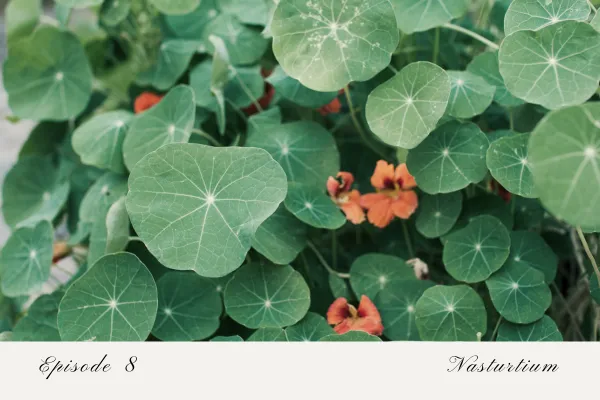
On this month’s episode of Flowers & Folklore Sarah tells you all about the nasturtium.
You can find Flowers & Folklore on Spotify, Apple Podcasts, Pocket Casts, YouTube and lots of other places.
Hello and welcome to Flowers and Folklore. If you love flowers and folklore and odd floral facts, then you're in the right place. Whether you've listened before or if this is your first time, we're so pleased you're here. I'm Sarah Rushbrook, a florist living in Glasgow in the UK.
I run a floral business called Rook Botanics, which I started in 2020.
And I'm Keely Rees. I'm speaking to you here from Canberra, Australia, where I've just started a new business, The Green Edit, a floral and creative studio.
Reading and learning about flowers and the history of folktales associated with them is a big hobby of ours. There's so many regional stories and lore for each flower, so you may have read or heard something different. You're absolutely welcome to get in touch and let us know. We're always keen to learn more.
I'll share the best way to get in touch at the end of the episode. Hi Keely! What lovely flowers do you have behind you today?
Hey, Sarah. Yeah, they're pretty, aren't they? I've got some carnations, which I know are some of your favorites. And I've got some Geraldton wax and then viburnum lace, which I was playing with for the first time, which it is so stunning. It looks like blossoms, but it doesn't have any fragrance at all.
And they're not, it's not as fragile. Yeah. But it's incredibly woody. I mean, I'm sure you've probably played with it. Have you? Yeah. I just found it really difficult actually to do what I wanted to do. It had a mind of its own. So I think you have to kind of let that one be the boss.
But it was, yeah, it was interesting. It was fun playing with them anyway. I've made a mess. Yeah.
yeah no that sounds so much fun and uh I know exactly what you mean how are you going so I've got a workshop this evening um we're recording well I'm recording early in the morning Kiwi's recording later at night and I'm doing a Halloween
dried floral headdress workshop oh wow that sounds amazing and spooky and magical
hopefully it's gonna be really good fun I have been drying out lots of flowers over the last few weeks. So I've got some Chinese lanterns. They just look like little dangling pumpkins. And I've got some roses that I've dried out and I've got some Spanish moss that looks like, it looks like cobwebs.
So we're going to, yeah, just put that in our hair and have fun.
Oh, that's incredible.
Oh my goodness. I'm so jealous. I want to be there. Today, Keighley, I'm going to be telling you all about the nasturtiums. I'm going to kick off with four floral facts. Tropelium magus, also known as nasturtium, is not closely related to the genus nasturtium, which includes watercress.
Number two, nasturtium leaves, like some other species, demonstrate the lotus effect. This is where rainwater will fall off the surface and it gathers in droplets, which then just rolls off, leaving it dry and clean. Number three, it is used as food by the larvae of the dot moth, the garden carpet moth.
and several butterflies, including the cabbage white. And number four, they are edible and it tastes a little like rocket.
Okay, I'm already really excited because I never knew that that's what it was called, the lotus effect. I was literally looking at some leaves the other day. I couldn't believe how the water was just sitting on it. And it wasn't absorbing into it and it was just like running off like it was dancing on the leaf.
And I was like, look at this. I like literally pointed it out. Look at this little droplet. It's like so cute. So I had no idea that's what that was called. Secondly, I'm so glad I know now how to pronounce that. That is so not how I heard it in my head.
But also why is it named nasturtium if it's not even closely related to the nasturtium? This is really bizarre. I don't understand.
It is really bizarre and lots of people have also been really annoyed by it. So we're going to start the episode with a disclaimer that these are two separate plants, nasturtiums and nasturtiums. They are. There's two different things. We're going to have a little tangent as well. So recently I've obsessively been playing the game.
tales of the shire and for people who aren't lord of the rings nerds this is obviously a game that is set in the shire which is where hobbits are from if you don't know that then i'm very disappointed um so in this game one of the tasks you
have to do is go foraging and during the winter months little patches of nasturtiums grow They're cute, they're green, orange, very little sweet plants. So I noticed that once you've collected them, it will tell you what you've collected. And it was saying, I've collected a nasturtian. So that is ending with an N rather than an M.
And so I had a little deep dive into why this was the case. And it turns out that in Lord of the Rings, Tolkien wanted to have them as a nasturtian rather than nasturtiums because he felt that this was accurate and the reason he
gave was in one of his letters he recorded a conversation between him and a gardener and he had asked this gardener what do you call them referring to nasturtiums and he said oh we call them tropeleum And he said, do you not call them nasturtiums? And he said, no, that's watercress.
And so the nasturtium genus is what covers watercress and various other things. But then there's the plant nasturtium as well. And there's some similarities that we'll find out about, but it is just incredibly confusing and Tolkien tried to stand his ground. And so I think there's some copies where in the book it is nasturtium.
Some books have it as nasturtium. And it was just quite interesting that lots of people seem annoyed about how confusing the name is.
Well, I don't blame them. I'm kind of on their side, to be honest. But I do love that the people who made that game, Tales of the Shire, are obviously Tolkien, because it's Weta Workshop, isn't it, that created it?
Yes.
I mean, they really understand the world of what Tolkien created. So I love that they respected what he wanted in the spelling and put that in. And I love that you literally have a game that your goal is to go and forage. I need to get this game.
It is really sweet. It is very cute. The nasturtium that we're going to be talking about is the flower that is bright orange. Sometimes it's red. Sometimes you can get pale yellow. But they have almost like their leaves remind me of geraniums, like the kind of shape that they have.
We are going to talk about the shape of their leaves later on in the episode. But it is also known as the garden nasturtium. It's known as Indian crests or monk's crests, which is even more confusing because it's water crests that is the part of the other genus. So let's just slide over all that. Moving on.
So, and if any of that is incorrect, you're welcome to write in, send us angry emails. Yeah. The name dropolion was coined by the Swedish botanist Carl Linnaeus, and it means little trophy. And so this is probably borrowed from ancient Greek. And it is quite interesting because
A lot of the research I did kept throwing up that it was related to warriors and strength and bravery. In The Language of Flowers by Odessa Begay, she wrote, In ancient Greece and Rome, it was customary for warriors to erect a trophy in the place on the battlefield where they felt an enemy.
This usually involved hanging the enemy's bloodied helmet, shield and armour from a tree branch or pole. The Swedish botanist Carl Linnaeus thought that the leaves of the nasturtium resembled these shields, that the petals were like a golden helmet and the colour like blood spilled on their armour.
He named the flower tropoleum magus after the Greek word tropion meaning trophy. It's a bit gross really.
It's like this dainty little flower with this like gory symbolism and origin story.
Yeah, that is quite funny because my mind was just like, oh, I like that. That's really, I like the gothicness of it. But yeah, I think most people would probably have your response, Keely.
It's just like delicate little flower. I was not expecting battlefield and bloodied helmets.
There was an old English name that I also came across called Yellow Lark's Heels. which just seemed, I think, very sweet, very poetic.
Yeah.
I'll give you a brief history of the plant. The species is of a cultivated, probably hybrid origin, and I think this is reflected in some of the folklore more accurately, like the lack of folklore that there is around this flower. It originated in the Andes from Bolivia north to Colombia.
The species has been naturalised in parts of the United States, as well as parts of Europe and Asia, Africa and Australia. And then I thought this was really interesting. It's listed as invasive in Hawaii and on Lord Howe Island in Australia.
I mean, I can kind of see how... They do seem to pop up a lot even here, I have to say. Like, I often see them. And I was actually just at someone's house a couple of weekends ago from Facebook Marketplace, and I was like, oh, my gosh,
I love your garden because I always chat gardens with people when I go to pick up stuff, obviously. And she's like, yeah, but I don't like these ones because they're orange and I'm going for blue and purple in my garden. And I'm like, I feel that. Yeah, so they just seem to pop up. So even here... Um,
so yeah, maybe they're just kind of taking over and smothering, mothering other plants and seedlings and things like that. Yeah. And if they are food to like bugs, I wonder if that then becomes an issue because then the bugs are like super happy and have way too many bugs or something.
Yeah, but I don't actually know how it spreads. So I wonder whether it is birds flying or whether it's like intentional and then it like just grew out of hand. Who knows?
Yeah, it'll be interesting too. It's our next research project.
Yeah. I mean, someone will know. Let us know. Let us know how it's spread so rapidly.
You do the research for us.
Yeah. So in the Victorian language of flowers, it was known to represent patriotism, which I thought was quite interesting because nowadays that would probably be the poppy. But it's interesting. I think that this is just another reference to... the greek story of having a trophy because i can't find out why else it would
represent that but i thought that was quite interesting does it look like a trophy to you i can see that it looks like a shield it definitely has like a triumphant
look about it i would say like it looks quite yeah it does have even though it's delicate i'd say it's quite it has quite an energy like a triumphant yeah yeah so i can see how they kind of connected it i think that's exactly the
right word triumphant yeah that's perfect um so cicely mary barker who wrote the flower fairies she thought the leaves looked like little brollies oh that's so cute isn't it sweet so she did an astertium flower fairy for the alphabet fairy series which was in 1934
So I'll read the poem, but Keely, do you want to describe what the drawing looks like?
Yeah, it's super cute. So you've got your little fairy and he's sitting on a nasturtium leaf with his legs dangling over. And he's got one of the leaves held up like a brolly. I'd say brolly, we say umbrella in Australia, but I like brolly. Vote for brolly.
um and he's got a little nasturtium hat and yeah he's sitting in amongst some gorgeous orange nasturtiums it's it's just gorgeous we'll have to put it on our
instagram yes yes we'll definitely do that um and so i would i would argue that she's called it a brolly so it fits with the rhyming couplet yes yes yes but also
it's a cooler it's a way cooler name
Yes. So I'll read you the first stanza, which is Nasturtium the Jolly. Oh ho, oh ho. He holds up his brolly, just so, just so. A shelter from showers, a shade from the sun, mid flame colored flowers, he grins at the fun.
That is so cute. I love it. I love it.
And then both Keely and I are really obsessed with the secret garden. And so one of my favorite books is called Unearthing the Secret Garden by Martha McDowell. And so I was really, really hoping that there would be mentions of nasturtiums in the secret garden. And there isn't. But in one of Frances Hodgson Burnett's houses,
so this was at Plandome, which is in New York, she planted Lots of nasturtiums that encircled the lawns. Next, I had a look at Beatrix Potter. Was Beatrix Potter big in Australia?
Yeah, I've definitely had it in my childhood and had the whole collection and loved it.
Okay, perfect. So nasturtiums are featured in the artwork of The Tale of Peter Rabbit. There's a letter recorded of her saying to, I think it's her publisher, that she was worried about the rather uninteresting colour of a good many of the subjects, which are most of them rabbit brown and green.
And so she solved this issue by adding in different flowers. And one of them was nasturtiums as they are obviously incredibly colourful. So there's a scene where Peter has lost his blue jacket. And I think he's still in Mr. McGregor's garden. And Keely, do you want to describe the artwork?
It's so beautiful. Peter is looking directly at the illustrator and looking a little bit frightened slash sheepish with a whole bunch of nasturtiums behind him. And it's really very clever that she's added in those bits of colour. And then there's also a little red robin just beside him as well.
And also he looks just like my bunny that I had, who was also called Peter after Peter Rabbit, but I just called him Bunny. He looks exactly like that. He's gorgeous.
That's so sweet. When you come to the UK, because it will happen, we will have to go to Hilltop House, which is Beatrix Potter's cottage. It's in the Lake District. It's gorgeous.
I'm never going to want to leave though. Like I'm going to get it. I'm not going to like, I just, yeah. Yeah. That's fine.
You can, I'll keep you.
Oh man. It's so beautiful.
There's a really special poem that I want to share with you. And I think this is one of my favorite things about doing flowers and folklore. is that it opens up my world to poems that I perhaps never would have come across. So there's a poem by Anne Bethel Spencer, and she was born in February 1882.
And her poem is called Lines to an Astertium. She was an American poet, teacher, civil rights activist, librarian, and gardener. So she was a busy lady. She was a prominent figure of the Harlem Renaissance. Spencer was the first Virginian and one of three African-American women included in the highly influential Norton Anthology of Modern Poetry.
So I'll read you the first couple of lines of this poem. A lover muses, flame flower, day torch, moana lower. I saw a daring bee today, pause and soar. That's so beautiful. It was centered around Harlem in New York in the 1920s and 30s. They sought to break free from white stereotypes, which had influenced their relationships,
their heritage and to each other. So I thought it was really important to acknowledge this poem by Anne, which is really, really beautiful. The speaker is addressing the flaming heart of the usually yellow, orange or red nasturtium. I think naming it flame flower is so evocative and just really accurate.
And the poem describes how the bee, the daring bee, is mesmerised by the flower. We can share a link to the poem in the show notes so you can read the whole thing.
Do you think she was inspired by the nasturtium calling it the flame flower and things like that because she was full of passion in her pursuit of revolution there? Like, do you think that it was maybe tied into the fire that they had for seeing change? Yeah.
Maybe. Yeah. I think that's a really beautiful reading of it. Red and orange, such vibrant red and orange does, feels passionate, but there's also like,
anger like underlying anger yeah yeah that's so true I have to say it's really interesting because my teacher today was talking about the language of flowers and how flowers speak and she actually was talking about how she's so passionate about the way she speaks about flowers it's so so beautiful and she talks about how they
they gave her hope and how it's like as she leans into the flower and she it's like the flower tells it tells her its secrets and that's how she learns to work with them and how to kind of arrange them and she was talking about how
they flowers don't speak with words but they absolutely do speak which is why you can't just give someone a bunch of flowers and not know that that implies something and not know what the meaning of the connotation behind that and I just found that really interesting hearing about
these really passionate things like these poems and the fact its origin story is related to battlefields and things like that. Like these are little humble flowers, but there's so much language around them and so much history. And it's just fascinating to me.
That's absolutely beautiful. I completely agree with that. That's so true. And then I think actually, yeah, we've been discussing how this flower does have associations with battlefields and strength and triumph. And yeah, I think that does... It makes the reading of the poem even deeper.
And I'll never look at Anastertium the same way again.
I know because they didn't used to be one of my favorites because they feel like a very 80s flower. They look a bit dated, like a bit vintage.
And they kind of look a little bit insignificant, but hearing all this story around them, I actually feel like, wow, they're like little bachelors.
Yeah, and I think the fact that they're now found in so many different places across the world, there's clearly some resistance to them. One painting that kept coming across... when I was researching was nasturtiums in a blue vase, which was by Claude Monet. And he had planted nasturtiums in the border. of his garden in France.
So it was along the pathway he planted orange nasturtiums. Do you want to describe again the painting in question?
Yeah, so it's a blue vase. It's actually more like a jug, a blue jug on a table in that very typical Monet. The table looks almost like water. You know how he's got that mottled look of his table and then the background is like A kind of dusty sky colour.
And then the nasturtiums are just gorgeous, vibrant orange. And the green of the leaves just kind of, they actually are almost climbing out of the jug rather than sort of sitting in it. It looks like they're about to spring out.
Yeah, that's beautiful. They really do look like they're about to spring out. Yeah, it's absolutely gorgeous.
They look different there to what, I don't know if it's just because of his style, like the way that he's very stylised in his painting, but they look a little bit more fluffy there or like they're more separated petals than what they are, do you think? Yeah, I completely agree. Because I wouldn't have thought they were nasturtium.
I would have thought maybe like a gerber or something.
Yeah, I think from the leaves and then how it's kind of, the leaves almost grow out like fingers and that feels very light in stertiums. But I know what you mean with the actual flowers. They do look fluffy. I don't think it's accurate.
No, maybe that was just his interpretation.
Yes. Yeah. Which I think is quite interesting then in comparison to Cicely Mary Barker, where all of her paintings, every flower she did was a hyper hyper realistic like she used sources from Q and things like that to make sure it was completely accurate but yeah I suppose Monet has artistic license to
yeah we'll let him do that I mean it's Monet so he's allowed but did you did you know that the creator of Brambley Hedge whose name has left my brain right now but do you know she when she was writing it and drawing it she was determined that every single
You know how she did it over the seasons, every single flower that she represented and plant and everything in each of those stories had to be in that season and they had to be accurate. They all had to have the exact right number of petals and the exact shape of the leaf and everything had to be,
it couldn't just be a made up flower. And I just, just made me love it even more. Yeah, I just, I just thought that was really interesting.
Wow. No, I, I didn't know that. And actually that's funny because obviously I always look at Beatrix Potter. I look at Cicely Mary Barker. I should start adding Brambly Hedge.
Also, it's between you and me. I've started making a Brambly Hedge treehouse dollhouse. Because I am that level of nerd. It's over here. I don't know if you can, can you see it?
No, no, no.
Keep going. Keely! And when I read her book at the intro saying that she wanted to make it as accurate as possible, I was like, right, that's it. I'm ripping out these circle windows and I'm putting them in exactly as she has them in the book.
And I'm going through and I'm like post-it noting like inspirations of furniture and things like that because I want it to be like as accurate and I'm going to choose which season it's in. So it's like...
Is there something wrong with me? No, no, this is perfect. This is just further proof that we are destined to be friends. This is the thing that I think would be a hobby that I could sink all my money in. I was always obsessed with having dollhouses and I never really got my dream dollhouse. And the idea...
I genuinely might just copy you like that.
This is totally, totally do it. And also, can I just show you one more thing? I'm sorry.
Yeah.
Can you see? Probably can't see. Can you see this massive dollhouse here in the corner? um your table yeah send me a picture yeah but um it's a whole thing um but i i bought a course on like dollhouse making so that actually i got it for my birthday
can you send me a link to it please because this is just further signs that this is a thing i love miniatures i watch videos of people making miniatures we're just
meant to pinterest board okay i'm sorry oh god it's so exciting this dollhouse i think i'm gonna make a florist shop Okay, good. I was worried you'd be like, oh my gosh, you're like a whole other level of nerd. No, that's perfect. Sorry, I totally went on a tangent. No, no, no, that was perfect.
I think it's safe to say that plenty of people have been inspired by the aesthetics and the appearance of Nasturtium's They've also been used as an edible flower and they've been used in medicine. And we're gonna have a little deep dive into different ways they can be used.
There was records of young Greek athletes who would massage oil of nasturtium seeds into their muscles after they had exercised. That was in The Witch's Garden by Sandra Lawrence. I'm gonna run through some of the medicinal properties of the nasturtium. And I will just say, Don't try these at home unless you have spoken to your doctor.
There was references of them being rich in iron and vitamin C. And so they would help a sluggish man arouse him from his torpidity, which I thought was an interesting way to describe it. They can also help with... They've been using skin and hair products to treat acne and dandruff.
To be honest, it looks like they've been used... for loads of different stuff with skin and hair there was also references for digestion that they help you purge which sounds a bit gross um they can help with appetite and absorbing food and again lots of references to having vitamin c so
they would be good for your immune system and preventing scurvy um there was also references of them being used in teas to help with your kidney and bladder there was also on one of the blogs that i was looking at was the header emotional and apparently they've been used to help people who suffer with lack of
attention which i think would um maybe nowadays being ADHD. But yeah, they just seem to be a bit of a cure-all, which you do see that before we had provable medicines, that they would, yeah, be a bit like throwing spaghetti at the wall and just seeing anything that will stick. Will it work for her?
Yeah, why not? Just try it.
There was a really nice article in Country Life by Mark Diocono as well, And he wrote, I won't lie and tell you I wake up on a bright spring morning, dreaming of growing and eating nasturtiums. That is reserved for mulberries, boysenberries, asparagus and their like. But quietly through the spring, summer and into autumn,
they give me months of pleasure and in a great many ways. I know they are a little gauche. There's something of granny's handbag about them. But bear with me, there are perhaps a dozen excellent reasons to give them space in your garden.
I felt like what we were saying earlier about how they feel like a bit vintage, a bit retro. I think granny's handbag is exactly the phrasing.
Yeah. I was just loving his, his way of expressing it there. That's so beautiful. Like so perfect. Yeah.
Yeah. And so I thought it was quite interesting. There were several references to assertions, meaning nose tweaker. And I think that was more because of that pepperiness. Like it can, yeah. Give you that, about to sneeze kind of feeling and then obviously we've discussed already how they
taste of rocket but there's also parts of them that are sweeter and taste a bit like honey so I just thought I will run through some of the suggestions that Mark has for how to consume them and so he said that the paler yellow flowers are
are milder than the darker red ones, which I thought was quite interesting. And I would like to put that to the test. He recommended using them in a mixed leaf salad. The combination of pepper and sweetness brings interest to a salad. They're great battered in tempura batter and deep fried, which sounds delicious.
I've had, have you ever had courgette flowers that have been deep fried? Oh yeah, yeah, yeah. Yeah, so I feel like it'd be like similar to that, which sounds delicious. The young leaves are succulent with a fresh grassy peppery flavour, which that kind of put me off. I don't like the idea of them being grassy.
No, no.
If they're picked small and young, then they're great in pesto, which is wild garlic is one of my favourite things to forage. And you always have to get it small and young because otherwise it can make a very stringy, very strong pesto. So that sounds absolutely delicious.
And then the seeds are really good pickled and they make like a Mediterranean caper. And then apparently they can save off cold if eaten raw by the handful. But I imagine that would be really unpleasant. On plantlaw.com, which is a website that collects like facts and stories and folklore about different flowers,
there were three entries for nasturtium and they were all about consuming them. There was one where someone's, eccentric great aunt would give them sandwiches of dandelion leaves or handfuls of nasturtium flowers if they were looking peaky and then there was one person who
recorded that um the bottom of the flower could be bitten off and then you could suck the nectar out of the flower there was also lots of references to protection but i couldn't find like really precise sources for where this came from. Just references to different cultures, seeing assertions as warding off evil spirits and negative energies.
I wonder if this is maybe more to do with their appearance and the fact that they're bold and fiery. And that was perhaps, yeah, seen as a protection. There was also lots of references to it being associated with the sun, which makes sense just because of the colour.
And so like the vibrant yellow and orange is very sun like. and then that is seen as a protective force. So there was a reference that nasturtium seeds were thought to possess a great power to repel serpents. This was recorded in a medieval herbal text, De Veribus Horabium Carmen, which was 1477. This was attributed to Mesa Floridus,
but it might have been written by a Roman poet, Aemilius Mesa. It's unclear whether this... was like a magical idea or whether it was to do with like the taste or the scent of them and I've not seen anything I've not seen any modern stories to say that
there's any connection between serpents and nasturtium but it would be interesting to see if there's any truth in that or whether it was just Nonsense.
Maybe it's the pepperiness gives you protection because it's so spicy.
Yeah, it could be. It could be that. There was also references to nasturtiums being associated with good luck and prosperity. And I think that that again was maybe... an appearance thing. The foliages are so lush and there is a sense of abundance. Like you never see just a tiny patch of nasturtiums.
It's always kind of overflowing and an excess of flowers. And so it makes sense that people kind of associated it with abundance and wealth. There was also references to some cultures having nasturtiums in their garden because it was believed to attract positive energy and financial success. But again, couldn't really pinpoint whereabouts that came from.
But I think it's similar, just that they're quite an abundant looking plant. The main theme that came through was patriotism. And in the language of herbs, nasturtiums were referenced to mean conquest. I think this all just links back to how it got its name, which I think is quite interesting that it's almost like the folklore came after
and was made to suit the name it was given. Rather than sometimes it happens that the folklore comes first and that influences the names that it's given. So I just thought that was quite interesting that it's just quite human nature to want to fill in the gap and make up stories.
There was lots of different references to a folk tale about. red nasturtiums and how they symbolize the blood of a dying warrior. And I think that these folk tales were probably just made up because it was just to do with how it was named. So I thought that was quite interesting.
Yeah, it's certainly got a war vibe from the tales that are coming through, doesn't it? It's all in battlefields and armor and triumph. Yeah, yeah. Conquest, you know, it's a lot for a little flower.
It is a lot for a little flower. And then there was something that this kind of blew my mind. And I thought it was absolutely fascinating. And it's quite nice that we're linking back to the botanist that named it, which was Carl Linnaeus. And he had a daughter called Elizabeth.
And she observed that the nasturtium flowers would appear to emit a tiny flashing light. And this would happen right at dusk. And so this is now referred to as the Elizabeth linear phenomenon. And what it actually is, is an optical illusion. And it's created by the way we perceive the color of the nasturtium against the
color of twilight, which is just, yeah. Sorry. That's it. It's wild, isn't it? And so they, they thought it was caused by electricity. And then there was a professor Thomas in Germany in 1914. He wrote a paper. that said he discovered that it was actually this optical illusion.
And as far as I could see, it was just nasturtiums that this happened with.
That's what I was about to ask, is it only nasturtium? And why then is it only nasturtium? Like it can't just be, surely, if it's just the way our eyes perceive the colour of a flower at twilight, wouldn't it be all flowers?
Yeah.
Maybe is it like the angle of the, I just, I need to know more.
I know. So, well, that's just to whet your appetite. We'll include in the show notes a link to this so you can read up about it. What a mighty flower to have like a phenomenon name after it.
Yeah, my whole opinion of the nasturtium has completely transformed in this conversation. They never really stood out to me in any way, but now I really, I don't know, I feel like they've got a whole story.
I love that so much. And I think that's the reason I chose this one was because even though that it's not, it's not got a ton of folklore about it, I was just like, there's so many interesting facts. And just such a storied history. And so now that you've joined the podcast and there's two florists here,
I thought it'd be really fun to finish with talking about how it's used in floristry because it's not a flower. I don't think I've ever actually worked with it. And so I just thought we could have a little chat about other florists who have used it. So one of my favorite florists is called Constant Spry.
And she was originally from Derby, which is where I was from. And she ended up being, she invented Coronation Chicken. And she was like florist to the royal family. Like her career is fascinating. In fact, we should do a bonus episode about her sometime. But she wrote lots of books.
And one of the books she wrote was called How to Do the Flowers. which I think is very um very descriptive and so I what does she mean like so many ways to read and so there is an arrangement in how to do the flowers of nasturtiums
and their foliage and it's in she's arranged it within a shell I think it's like one of those conch shells it's very interesting and she said in the book that these flowers look well when they are best picked in bud and then they're allowed to open whilst they're in the water.
So do you want to have the picture? It's obviously black and white. Do you want to have a go at describing how the arrangement looks?
It kind of looks like it's drooping or falling over the shell. It's almost like the shell is wearing a dress and like a big flouncy skirt and it's like dripping all over the bench that it's sitting on.
That's perfect. That's much kinder than what I was going to say because it just looks like a mess.
Well, maybe that too.
Yeah, but I think I say that in a positive way because I am the biggest fan of messy floristry. But it's quite interesting that we transitioned from that kind of style into then, I feel like the 70s and the 80s, was really about restricting and making flowers straight and kind of really penning them in.
Whereas this, you know, came first and had this wildness about it. And then there was another book called A Year in Flowers. will include this in the show notes and it said that nasturtiums had a vase life of seven to ten days which i thought was actually quite impressive um and they said
again harvest the flowers just as their opening and then if you're using the entire vines harvest when the foliage becomes leathery or firm to touch i i'm gonna try and get i think it's too late this year but next year i'll try and get some nasturtiums and maybe put them in a bouquet or something that
could be quite fun definitely yeah you have to after this and then you can put the
photos in the episode after the fact yeah oh i should have been more prepared and done it this year but
No, it's something to look forward to for next year.
Yeah, perfect. Thank you so much for listening today. I hope you've enjoyed it. If you have some interest in folklore about the flower that we discussed, we would love to hear it. You can find us over on Instagram, which is at flowers and folklore podcast.
And if you use Substack, you can subscribe and come and chat to us over there. And that's just flowersandfolklore.substack.com. You can also share this episode with a friend, subscribe to the show or leave us a review on Apple Podcasts or Spotify or wherever you listen to podcasts. Alternatively, you can do none of those things. That's absolutely fine.
Me and Keely are just so happy that you've listened to this episode.
Agreed. Thank you so much everyone for listening. And if you'd like to get to know us better, our last episode is a Meet Your Hosts episode where Sarah and I talk about how we met, how we came to find flowers, or should we say how flowers found us.
And we talk about our least favorite and favorite and least favorite flowers. And we would love to have you over there and you could introduce yourself as well in the comments so we can all get to know each other and talk nerdy flowers together.
That's our dream.