Episode 6: Tulip
Episode 6: Tulip
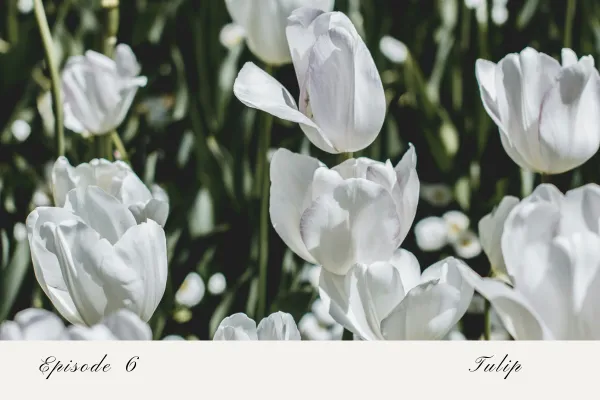
On this month’s episode of Flowers & Folklore Sarah tells you all about the tulip.
You can find Flowers & Folklore on Spotify, Apple Podcasts, Pocket Casts, YouTube and lots of other places.
Hello and welcome to Flowers and Folklore. I'm Sarah, a florist living in Glasgow in the UK. I run a business called Rook Botanics, which I started in 2020. I create flowers for funerals, weddings, I run lots of workshops, and I now host this podcast. I also write a newsletter called The Foibles of a Florist.
You can find a link for it in the show notes. If you love flowers and folklore and odd floral facts, then you're in the right place. A quick note before we get started. I love reading and learning about flowers and the history and tales associated with them. There's so many different regional stories and so much lore,
so what you may have heard or read may be different to what I talk about in the podcast. You're absolutely welcome to get in touch and let me know what you've heard. I'm always keen to learn more. If you stick around till the end of the show,
then I'll share the best ways for you to get in touch. On with the show. Hello and welcome to the latest episode of Flowers and Folklore. Today we are talking tulips. Spring has arrived in the UK. The clocks have changed only yesterday. And that means tulips are very much on the way or they may have even already
arrived wherever you are. This was a fascinating flower to research. It really highlighted how little I knew about tulips. So I'm very excited to share that with you. We'll get started with five quick facts. Number one, There's over 3,000 registered tulip varieties. Number two, tulips are native to Central Asia. Number three,
today Holland is the largest producer of tulips worldwide, exporting about 3 billion bulbs per year. Number four, tulip petals and parts of the bulb are edible. although it's not recommended that you do eat them. Number five, tulips continue to grow when they're cut. I always like to start the episode looking at the etymology of whatever flower
we're talking about. And the tulip was a bit of a difficult one. We're going to talk about this in more detail later on in the episode. But the tulip isn't native to the UK and it was only brought over in about the middle of the 16th century. And so the tulip doesn't really have many other common names.
One of the very few names that I found was Pot of Gold, which will be quite interesting when we talk about some of the folklore around tulips later in the episode. And I've only ever known of it as a tulip. But if you do have a common name for it,
if you've heard anything that's local to your area, please do let me know because I'd be fascinated to hear. The name tulip can have its roots traced back to a Turkish word that means turban or muslin, which is why it was given to the tulip, because of the flower's resemblance of a turban.
in the victorian language of flowers there's a few different references for tulips so this is a flower that comes in very many different colors and so in margaret pixton's the language of flowers which is my go-to book for um floriography she's listed red tulips as the declaration of love variegated tulips to symbolize
beautiful eyes and then yellow tulips symbolise hopeless love when i was looking into the symbolism of the different colours for tulips i got a lot of different answers and so i think it's very dependent on culture and location for what tulips represent in the poem the tulip
fairy by cicely mary barker she sums it up so neatly in her line too many hued to name them all red yellow pink or white and some are splashed, and some may be as dark as any plum. In the illustration that goes alongside this poem, Barker has created a flower fairy that's wearing a tulip skirt,
and then a collar of tulip petals around her neck as well. And then she's also wearing a little turban made from a little tulip head, which I thought was very appropriate given the etymology of the word tulip. Tulips have long inspired people in the literary world, Tulips is a poem by American poet Sylvia Plath. Ted Hughes,
the husband of Sylvia Plath, said that Tulips was written about some flowers that Plath received while she was in hospital. E.E. Cummings' first book of verse was called Tulips and Chimneys. But I want to highlight that tulips were, and still are, a really rich topic within Persian poetry and literature.
There's one poet in particular that I wanted to mention, which was Samin Bedbahani, who the BBC described as a formidable Iranian poet. and fearless activist. She frequently used tulips within her work, particularly towards the later part of her life. There's one poem that I particularly enjoyed called It's Time to Mow the Flowers.
The last three lines of the poem are My heart is greener than green Flowers sprout from the mud and water of my being Don't let me stand If you are the enemies of spring If poetry is your thing, I would definitely recommend checking out her work. Unsurprisingly, there's a lot of famous paintings that feature tulips.
A lot of these were made during the Dutch Golden Age, which we're going to talk about later in the episode. But this style of painting is one of my favourites, and I use it a lot to inspire the type of floristry that I do.
Okay, at the start of the episode, I mentioned that tulips aren't native to Europe. Not sure if this is embarrassing to admit, but I didn't realise that until I started researching this episode. They're so heavily associated with Holland that I just assumed that they were native there.
They're actually native to Central Asia as they grow really well in rough mountain areas. There's an old Persian legend that I'd like to share with you. I kept coming across this story whilst I was doing my research and each retelling of the story was a little bit different,
which is quite common for stories that have been passed down from generation to generation. The story tells of the origin of the first tulip as well as the doomed romance of two lovers. It did remind me of Romeo and Juliet. So there's a Persian prince who falls in love with the princess of Armenia.
Their love is tested and there's a series of events that keeps them apart and keeps them from marrying. During this time, there's a sculptor named Forehead who falls in love with the princess. He plans to marry her. The Persian prince is not happy about this and unlike the sculptor,
he has resources and so he excels him to the mountains. The prince tells the sculptor that he needs to complete a task. The prince believes this task to be impossible and it's to carve stairs into the cliffs. Whilst the sculptor is away in the mountains attempting to complete this task,
he receives false news that the princess has died. He then flings himself off the mountain in deep despair. It's not true though and the princess hadn't died. The ending has a few different versions. There's one version where when the sculptor kills himself there's drops of blood on
the ground and where the blood falls red tulips spring from the ground. In another version the princess who is actually in love with the sculptor goes to the mountains to look for him and then when she discovers his body she also kills herself and then where both their bodies lie red tulips grow from the ground.
And so how did a flower that is steeped in Persian mythology and culture make its way over to Holland and end up being the national emblem? It's unknown precisely when the tulip came to Europe. Many seem to think that it was first imported from Istanbul, and then during the middle of the 16th century,
it made its way to Europe. In one of my favourite books, The Language of Flowers, by Odessa Begay, she writes, It's known that the first tulip to bloom in Europe was in the garden of Johann Huart, in Augsburg, Bavaria in 1559, as recorded by the Swiss botanist Conrad Gesner. After the tulips' introduction,
the bulbs were gradually spread throughout Austria, Germany, Italy, France, England and the Netherlands. Holland's proximity to the coast and its sandy soil provided a particularly hospitable environment for tulips. Tulips really captured the imagination of people in the West and there was an absolute boom to have and grow tulips.
The Dutch in particular were just absolutely taken by the tulip. And as a result, something called tulip mania took place. So this happened during the Dutch Golden Age. And it was 1634 where there was just this huge increased obsession for tulip bulbs. But like all bubbles, it would eventually pop. And this happened in February 1637.
So roughly there was three years at the height of tulip mania. Because so many people wanted to get their hands on bulbs, the price just absolutely skyrocketed. And people were paying a a small fortune. There was somewhere that I read that one tulip bulb would cost more than expensive jewellery. So they were really, really sought after.
In 1638, there was a bulb, a single bulb, for a variety that no longer exists, but an incredibly beautiful variety called Semper Augustus. It was advertised as as being 13,000 florins, which at the time would have been the price for a house. The Tulip Museum in Amsterdam, which I can't believe that exists and I absolutely must visit,
it describes this variety as deep crimson flares against a milky white base. This bloom has been a source of awe and admiration for for hundreds of years as the king of tulips. I'd highly recommend looking up the Semper Augustus variety. It is absolutely beautiful but I think you would probably recognise it as well.
It was featured in lots of paintings from the Dutch Golden Age and I love the Dutch masters as a source of inspiration for my floristry. They use a lot of really rich colours and dark backgrounds But there's one famous watercolour painting from the 17th century of the Semper Augustus.
I recognised it, like I'd definitely seen it around a lot. But unfortunately, the artist is unknown. And also, unfortunately, this variety has died out. The way it got the flares of red against the white. was through a process called breaking. Tulip breaking is where there's a virus within the bulb that it does weaken the bulb,
but it creates the variegated colouring that you see. It does seem really fascinating because it obviously opens up so many options for different types of tulips and so many different colours. But back to tulip mania, this was around the time that tulip vases became really popular or tulipieres. I think that's what they're
actually called this is those ceramic vases where they have individual holes for each flower and now it makes sense in this context that you know each stem each tulip would have been so expensive that you'd want a vase where every single flower was on display which is perhaps quite different to modern floristry now where
there's usually such an overabundance that you know some parts of the flowers get hidden and I absolutely covet having a tulip vase. I would love one of the really intricate, like, over-the-top designs that you can get. Eventually, the tulip market collapsed. There was a few factors that contributed to this,
but one of them was there was an outbreak of the buponic plague. And so there'd be people who would be attending bulb auctions that would have the plague, and so this scared people away from attending, so they wouldn't also get sick. The collapse in the market did leave many people, many Dutch people, in financial ruin.
But despite this, tulips do remain one of the top exports for the Netherlands. They are the world's leading supplier of commercial tulips. I think they produce about 2 billion tulips per year, which is just, yeah, mind-blowing. During the Dutch famine in 1944 to 1945, because there was such an abundance of tulips available,
this became a source of food out of sheer necessity. And Dutch doctors provided recipes. It is worth pointing out that there is parts of the bulb that are poisonous, so please don't be eating tulip bulbs. Also, they're not meant to be very nice either. So I know this podcast is called Flowers and Folklore,
but in Britain there is very little folklore about tulips. A lot of my go-to books that I use for this podcast just came up empty and I think learning about the history, it makes sense. In The Complete Language of Flowers by Teresa Dietz, she writes... All the flowers that I've covered so far...
would have grown freely in wooded areas or just out in the countryside. This just wouldn't have been the case for tulips, at least not in Britain anyway. And so the few references to tulips that I could find in folklore, they were associated with prosperity and money which makes sense because they're expensive.
So in the complete language of flowers Teresa Dietz notes that if you place tulips in a vase in a kitchen this will attract good and plenty into the home and I think that's probably because if you were able to afford tulips you already had plenty. There were also references to wearing tulips as a
protection against bad luck and poverty. But again, like if you were able to wear a tulip, then you were very far away from poverty. I did manage to find a piece of folklore about pixies and Dartmoor tulips. I wasn't able to find any dates to when this originated, but it was on the dartmoor.gov website.
So obviously it's very official and very true. To the pixies who live in Dartmoor, they would be friendly and really helpful to the people who are nice to them. But the people who upset or frustrate the pixies, they will feel the wrath. A long time ago, near the middle of Dartmoor,
On the edges of a small village there was a thatched cottage and in this cottage there was an old woman who lived all by herself. Despite this she was never lonely. She was visited by children from the village and she made friends with animals and birds and she would share her food with them.
Many of the local birds were able to survive throughout winter because of this old lady. So at the back of her cottage the woman tended a really beautiful garden that she absolutely loved and grew the most beautiful flowers. One night, when she was tucked up in bed about to fall asleep, she heard the sound of music,
so she looked outside of her window. To her amazement, there were pixies dancing on her lawn. They were completely unafraid and unbothered by the woman. The tulips that the old woman had planted caught her eye. They were swaying in time to the music, and when she peered closer,
she noticed that in each cup of the tulip was a tiny little pixie baby. It was fast asleep, being rocked by the sway of the tulips. She was absolutely delighted to witness this. She was so happy that the Pixies trusted her to be visible in front of her,
but also really honoured that they chose her garden and her tulips to care for the young Pixies. But inevitably, the old woman died peacefully in her sleep. Her beautiful cottage and her beautiful garden were taken over by another occupant, an old man. He didn't approve of her flowers,
he thought they were a waste of space and decided to dig them up and plant some vegetables instead. He didn't want to share his food with the birds and the animals and so he chased them away and put a fence around the garden.
And the pixies, they were not happy about this and he was about to feel their wrath. The pixies were annoyed that they no longer had a space to dance, and so they cursed the garden and made sure that not a single vegetable grew. The pixies didn't forget the old woman, though, and on her grave,
flowers continued to bloom throughout the year. I also wanted to take some time to talk about using tulips in floristry. They're a flower that I didn't really used to enjoy working with, they're a flower that kind of has a mind of its own and so you can't really control
them and when I started out in floristry I was in quite a traditional setting and so a good chunk of what I was taught was like how to make flowers look the way you want them to whereas now I embrace a more natural approach and so I let flowers
kind of dictate where they want to be and how they want to look and so I've definitely enjoyed working with tulips in the last few years It can sometimes be a bit stressful if you create something the day before and then overnight they have completely changed the direction that they were pointing in.
Sometimes it can be nice when you get a lovely drooping tulip and then overnight it perks up and it can ruin the design that you're trying to create. But I also kind of like that that They are kind of like an ever-changing shape.
They are, there is a bit of a joke about how tulips can be really squeaky. And if you've ever had like a couple of tulips in your hand, you'll know what I mean when the stems rub against each other. But what actually makes a tulip droop? I don't know whether ad classist says folklore,
but certainly like old wives tales as to the best way to make tulips not droop. And so I kind of don't care anymore. Like, I don't mind if they droop. I think it's just a part of being a tulip. I know there's some people, though, who would like to not have droopy tulips, and that's totally fine.
I did a test last year to see whether any of the methods that are usually talked about, whether they actually work or not. Basically, I don't think they do. I did a test where I had, I think it was maybe five or six different pint glasses with a bit of water in. And in each pint glass,
I put a different tulip, but they were tulips from the same wrap of flowers. And I think this is important because I think the biggest factor in whether they droop or not is the type of tulip that they are, but also how they were transported as well.
I think temperature plays a big role in whether they droop or not. And so I placed a tulip in each glass. One had a penny in the water. One had a pinprick. One I cut every single day. One I put into warm water. And then I had a control tulip where I did none of those things,
put it into cold water and they were all kept in the same place. And they all drooped a little bit except the one that I was cutting because less stem to start drooping. And so it was only one test and so it's not conclusive but it kind of showed that putting a pinprick in did absolutely nothing.
But I would be really interested in hearing whether you have a method that you use. I think there's some people who always prick their tulips and then because of perhaps the variety that they've got or the place where they've put them in their home. the tulips don't droop.
So then in their mind, they think, well, the pinprick works. I think it would be really interesting if everyone tried a different experiment to see whether it works. So you could either choose the penny method or the pinprick method. But then as long as you have a control tulip alongside it,
then you'll see whether it's actually worked or not. And I know, like, I'm maybe being too nerdy about this, but I find it really irritating that there's often lots of like clickbait headlines saying, this is the thing you need to do to stop your tulips drooping.
And they've just like quoted someone who says, yeah, this is an expert florist. This is what you should do. But there's never actually a study with data to go alongside it. And so I just don't, I just don't believe it. But maybe I'm being really cynical. So whilst researching this episode,
I came across several headlines about wild tulips being under threat. I came across a blog post with a Cambridge University researcher, Brett Wilson, who had done lots of research into why the wild tulips are suffering. And it is because their natural habitat is changing rapidly because of climate change. And so it's really weird to think about tulips,
which in the UK seem so abundant and, you know, so plentiful, that actually there's a good chance that wild tulips will be extinct. So I'll include a link in the show notes if you want to look further into it. But I just, it felt really important to highlight this fact.
It's not something that I was aware of before. And I think it's quite, you know, important to try and preserve these varieties of tulips. I don't want to end the podcast on such a sour note. So I'm going to tell you about the Audrey Hepburn tulip.
So I wasn't aware that Audrey Hepburn was of Dutch descent and she had a real love of gardening and particularly loved tulips. When she was younger, her family travelled regularly and they took refuge in the Netherlands during World War II. But the Nazis came to occupy the Netherlands and this led to a lack of food.
And so in the book, Audrey at Home, Memories of My Mother's Kitchen, which was written by Hepburn's son. He wrote about Audrey and her family relying on boiled grass and tulip bulbs to avoid starving to death, which I know obviously is very bleak and we want to be ending on a good note,
but I wanted to mention that the slightly happier note was that the white tulip was Hepburn's favourite flower and in 1990, A snowy white tulip was developed in Holland and was named in her honour both for her career and her charitable work with UNICEF. Her son said that during the ceremony dedicating the tulip to her,
this honour was the single most romantic thing that happened in her life, which is just, which is beautiful. Music For a list of the sources that I used for this episode, please head over to my Substack. There's a link in the show notes. Substack allows you to leave comments on each episode as well.
So if you have any thoughts or feedback, please let me know. Unless you've only got horrible things to say, then, you know, you can just scroll past. It would be really great if you could share this episode with a friend, subscribe to the show or leave me a five star review.
Alternatively, you can do none of those things and that's totally fine. I'm just so pleased that you're here. Thanks for tuning in and I'll see you next month.